Best massage guns under $100
Under $100 you are not buying a "recovery system". You are buying a motor, a battery and a plastic shell. Four numbers decide whether it feels like a real percussive tool or a buzzing toy — and none of them appear on the prettiest product photos.
What a massage gun actually does
A percussive device drives a head in and out at roughly 20–53 Hz with a stroke of 8–16 mm. That's it. The physiological effect is short-term: increased local blood flow, reduced perceived tightness, a bit of gate-control pain relief while it runs. It is not breaking up scar tissue, "releasing toxins", or lengthening a muscle. Anyone selling you the latter is selling you a story.
Which is good news: the useful part of the machine is mechanical and cheap to build. A $44 gun with honest amplitude does the same job as a $199 gun for the 10 minutes you'll actually use it. The expensive ones win on noise, battery, and the ability to keep the motor from stalling when you lean in.
Four numbers that decide the experience
1. Amplitude (stroke depth) — 10 mm minimum
Amplitude is how far the head travels. Under 8 mm, the device vibrates the skin instead of reaching muscle; above 12 mm it starts to feel like a proper tool. Large-format guns reach 16 mm but weigh more than most people want to hold for ten minutes. For home use, 10–12 mm is the sweet spot, and it is the single spec most cheap listings hide. If a listing never states amplitude, assume under 8 mm.
2. Stall force — the spec nobody publishes
Push a weak gun into a tight quad and the motor stops. That's stall. Rated stall force (in kg or lb) tells you how much pressure the motor survives before giving up — 20 kg is usable, 30–40 kg is good, and brushless motors hold speed better under load. If the listing only says "5 speeds" and "deep tissue", assume the motor is cheap and press gently.
3. Noise at arm's length — under 55 dB
This is where budget guns live or die in a shared flat. A gun rated "quiet" at 45 dB is usable in front of the TV; a 65 dB one sounds like a drone and you'll stop using it in a week. Owner reviews complaining about "high-pitched whine" are the tell — that's gear noise, not motor noise, and it doesn't improve.
4. Weight with the battery in
Full-size guns run 1.0–1.4 kg. That's heavy at shoulder height and fine on legs. Mini guns (0.4–0.6 kg) are the ones people actually carry and use on the go, at the cost of amplitude. Decide which failure mode you can live with: too weak to matter, or too heavy to pick up.
| Spec | Don't buy below | Good at this price |
|---|---|---|
| Amplitude | 8 mm | 10–12 mm |
| Stall force | not stated | 20–35 kg |
| Noise | 60 dB | 45–55 dB |
| Battery (real) | 90 min | 180–360 min |
| Heads included | 2 | 4–6, with a flat and a ball |
Bluetooth pairing, guided routines and "AI recovery scores" on a $60 gun are marketing surface area. They add a login screen, a dead battery and a deprecated app to a device whose only job is to oscillate. Buy the version without it and save $20.
Two claims to ignore
"Professional grade / used by physios." Physios use devices with documented amplitude and stall force, and mostly they use their hands. A badge on a marketplace listing proves nothing.
"Up to 3,200 RPM." Top speed is the least useful number: nobody uses the highest setting on a tight muscle, and cheap motors lose most of that speed the moment you apply pressure. Ask about stall force instead — and notice when the listing won't answer.
How we score
Scores are spec-based, not lab-tested: published amplitude, stall force and noise figures where available; motor type (brushless vs brushed); battery capacity in mAh and claimed runtime; the accessory set; and owner reports about motor whine and battery fade over 6–12 months. Where a manufacturer doesn't publish a number, we say it's unpublished rather than guessing.
Our picks
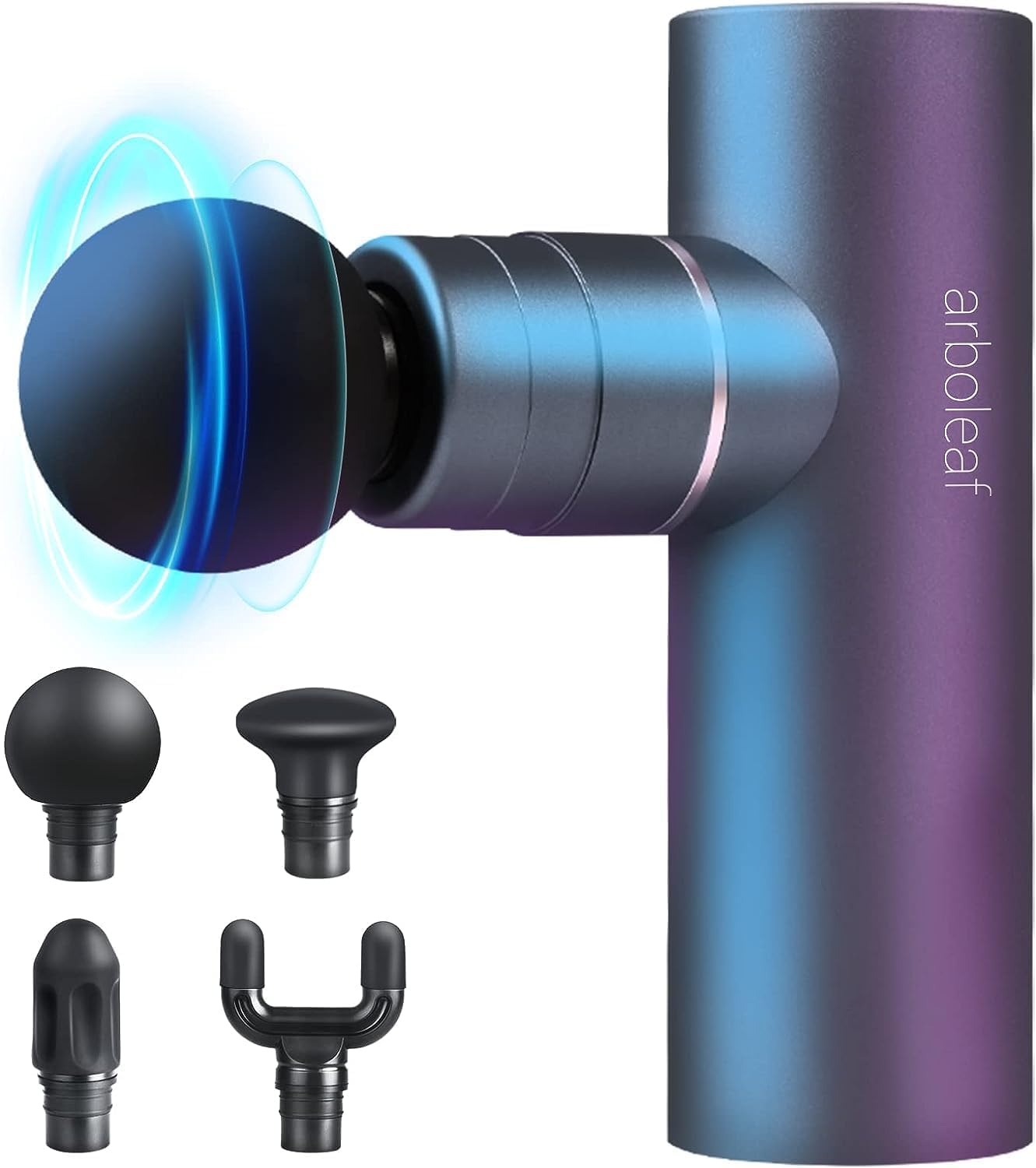
Arboleaf mini massage gun (CM20F) — ~$40–50
The brand's ultra-portable percussion model: a 0.9 lb full-metal body, a quiet brushless motor, five speed settings plus an AI-adaptive mode that adjusts intensity to the pressure you apply, and a set of interchangeable heads. The trade-offs are the usual ones for this bracket — amplitude and stall force aren't meaningfully published, so treat "deep tissue" as a claim rather than a measurement, and expect gear whine at the top speed setting.
Who should skip it: anyone who needs a genuinely quiet device for a shared room, or who wants to press hard into a large muscle group — that's a brushless 12 mm gun in the $120–200 band.
Check price on Amazon →A full-size brushless gun, ~$120–200
12 mm+ amplitude and a published stall rating. If your use case is daily deep work on large muscle groups — or you need it genuinely quiet in a shared room — this is the tier where those problems actually get solved.
Who should not use one
Skip percussive therapy on: recent fractures or sprains, open wounds, varicose veins, areas with metal implants or a pacemaker nearby, the front of the neck (carotid), the spine itself, and any area that's bruised or inflamed. If you're pregnant, on blood thinners, or have a clotting disorder, ask a clinician first. And "it hurts so it must be working" is not a rule — a gun should feel like pressure, not pain.
When to stop shopping
Stop at $50 if: you want 10 minutes on legs and shoulders after training, three times a week, at home. The physics of percussion are not expensive, and the extra $150 buys quietness and durability, not a better stretch.
Don't stop at $50 if: you'll use it daily for a specific chronic issue, you need it silent in a shared space, or you're treating large muscle groups where stall force matters. Then buy brushless, 12 mm+, with a published stall rating — and expect $120–250.
Don't buy any of them if what you actually want is mobility. Ten minutes of loaded stretching and a $20 lacrosse ball will beat a gun you use twice.
FAQ
Do massage guns actually help recovery?
They reliably reduce perceived tightness and soreness for a while, and feel good before training. Evidence for faster actual recovery is weak. Treat it as comfort, not treatment.
How long should I use one?
60–90 seconds per muscle group, two to three times a week is plenty. Longer doesn't add benefit and increases irritation.
Can I use it on my neck?
Not on the front or sides of the neck. The back of the neck and traps are fine at low speed with light pressure — avoid the spine itself.
Why does the motor stop when I press hard?
That's stall — the motor lacks torque for the load. Budget brushed motors stall at low pressure. Ease off, or buy a brushless gun with a published stall force.
Are cheap guns safe?
Generally yes, with the caveats above. What fails on budget units is the battery and the gear train, not safety systems — so don't leave one charging unattended overnight.
Related: Best smart scales 2026 · Wellness category · All buying guides