Best smart scales 2026
A $30 scale and a $150 scale will estimate your body fat within roughly the same error band. What you're actually paying for above $30 isn't accuracy — it's whether the data is pleasant enough to keep looking at in month six.
The uncomfortable truth about body fat
Every consumer smart scale uses bioelectrical impedance analysis: a tiny current runs up one leg and down the other, and the scale infers body composition from how much resistance it meets. That signal is affected by hydration, recent meals, salt, alcohol, room temperature, the sweat on your feet, and where you stand on the plate.
The practical consequence: the absolute body-fat percentage is not a measurement, it's an estimate with a wide band — typically a few percentage points either way, and different brands will give you different numbers on the same body. Anyone advertising "99% accuracy" or "medical-grade" on a $40 bathroom scale is describing a lab method (DEXA, hydrostatic weighing) that the product does not use.
What the scale is good at is direction and relative change, measured consistently. A 7-day average that moves from 24.1% to 22.6% over ten weeks is meaningful. A single Tuesday reading that jumps 2 points after a salty dinner is noise.
| Worth trusting | Treat as a rough guess |
|---|---|
| Weight, to ±0.1 kg, on the same floor | Body-fat % as an absolute number |
| Week-over-week and month-over-month trend | Visceral fat "level" (usually a 1–20 index, not a unit) |
| BMI (it's just arithmetic — but a blunt tool) | "Metabolic age", "body score", "protein %" |
| Whether you logged the day | Muscle vs. fat split to the decimal |
| Multi-user separation in one household | Hydration %, which the estimate is partly derived from |
Weigh at the same time, first thing in the morning, after the bathroom, before food or water, bare feet, same spot on the same hard floor. Do that and a $30 scale produces a more useful trend than a $150 scale used randomly. Skip it and neither one tells you anything.
The four specs that actually matter
1. Repeatability, not "electrode count"
Step on the same scale three times in a row. If the weight drifts by more than 0.2 kg, the load cells are cheap and every number downstream inherits that noise. Four load cells under tempered glass is the norm above $25; what varies is calibration quality, and that's what owner reports are for — search the model name plus "inconsistent".
2. An app that lets you get your data out
This is where budget scales quietly fail. If the app keeps your history in the cloud with no export, you're renting your own trend line. Look for CSV export, or a scale that syncs to Apple Health / Google Fit / Fitbit / Garmin — those act as an escape hatch. A subscription for "advanced insights" on a bathroom scale is a hard no.
3. Multi-user recognition that works
In a two-person household, a scale that can't reliably tell you apart produces interleaved data that looks like wild weight swings. Automatic recognition by weight range works fine when housemates differ by 10 kg or more; it fails for similar-sized partners, so check that manual profile switching is also possible.
4. Offline buffering
If your phone isn't nearby, does the scale store the reading and sync later, or discard it? Cheap models discard. Since the whole value is the unbroken series, this one small feature decides whether month four has holes in it.
Three specs to ignore
"8-electrode segmental analysis." The electrode count itself isn't the lie — it's the configuration. Real segmental analysis needs hand electrodes plus foot electrodes and a consistent grip. A $50 scale with four foot pads under the glass cannot separate left arm from right arm no matter what the app draws, so treat any "8-metric segmental" claim on a foot-only scale as a model's guess. A scale with a genuine detachable hand unit (like our pick) is a different machine — and should be judged by whether you'll actually hold it consistently for every measurement.
"Clinically validated." Validation studies compare a device to DEXA in a specific population. It doesn't transfer to you, and the claim on a marketplace listing is usually unattributed. Ask which study; nobody answers.
Bluetooth 5.x version numbers and "supports 24 body metrics". Metric count is a marketing axis. Three metrics tracked for a year beat twenty-four looked at twice.
How we score
We don't claim to have run a lab study. Scores here are spec-based and built from four weighted inputs: published specifications, the app's data-export and integration path, owner reports about load-cell drift and app breakage over 6–12 months, and price against the accuracy ceiling described above. Where a claim can't be verified from the manufacturer's own documentation, we say so instead of repeating it.
Our picks
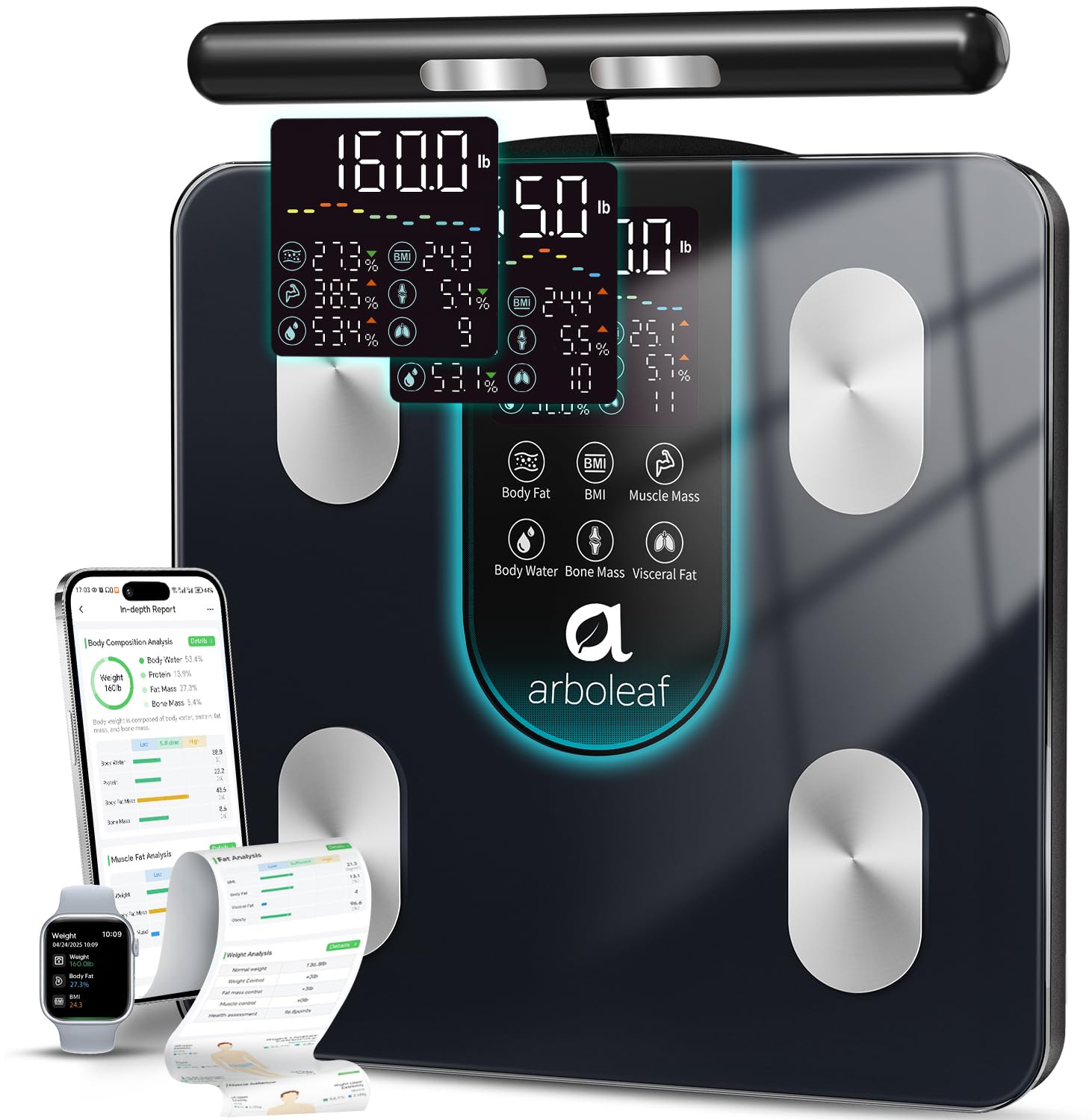
Arboleaf dual-frequency 8-electrode body-composition scale — ~$20–40
The unusual one at this price: dual-frequency BIA with eight electrodes including a detachable hand unit, which is the configuration that can actually attempt segmental analysis — not the foot-only kind we tell you to ignore below. The display board shows weight plus key stats without opening the app, the app tracks 50+ metrics with trend charts and family profiles, and syncs to Apple Health / Google Fit. No subscription.
Who should skip it: anyone who wants a number they'd quote to a doctor, or who won't use the hand unit — without it, it behaves like an ordinary foot-only scale. Street price moves between $20 and $40; check before ordering.
Check price on Amazon →A premium scale with a documented export path (Withings-tier, $100+)
You're buying software and a validation story, not a better sensor: long-term data retention, real CSV/API export, health-platform sync, and readings that survive app redesigns. Justify it only if you'll keep the series for years or share it with a clinician. Otherwise the premium buys nothing you'll feel.
Using it so the number means something
Pick one weigh-in window and never change it. Log it and forget the daily figure — read the 7-day average instead, because day-to-day water shifts of 1–2 kg are normal and will make you think a good week was a bad one. Then judge body composition on a 4–6 week cadence, alongside something the scale can't lie about: waist circumference at the navel, and a lift or cardio benchmark you repeat monthly.
One trap worth naming: if you're dieting hard or training for a race, hydration swings dominate the impedance reading and body fat can appear to rise while you're losing fat. That's the estimate breaking, not you.
When to stop shopping
Stop at $30 if: you want a weight trend you'll actually maintain, you're one person (or housemates differ in size), and you'll accept body fat as a direction rather than a diagnosis. This covers the large majority of buyers.
Don't stop at $30 if: you need long-horizon data you can hand to a clinician, you want integration with a training platform that requires a specific API, or two similar-sized people share it. That's a $100+ problem, and it's about software — no amount of extra electrodes on a cheap scale fixes it.
Don't buy at all if: your actual goal is a body-fat percentage you can trust. A $15 tape measure and a monthly photo do more for that than any consumer BIA device, and a DEXA scan once a year costs less than a premium scale.
FAQ
Is a smart scale accurate for body fat?
No — it's an estimate with a band of a few percentage points, and it moves with hydration. Use the trend, not the absolute number, and never compare readings between different brands.
Do I need to be barefoot?
Yes. The current passes through the soles of your feet; socks or shoes break the circuit and you'll get either an error or a weight-only reading.
Does it work on carpet?
No. Carpet and rugs absorb the load-cell deflection and readings drift. Use a hard, flat floor, and always the same spot.
Why does my body fat jump 2% overnight?
Water, salt, alcohol, a late meal, or a hard training session changing hydration. It's the estimate reacting, not your body changing that fast. Judge the 7-day average.
Are the "visceral fat" and "metabolic age" numbers real?
They're model outputs derived from the same impedance signal, not independent measurements. Directionally interesting over months; worthless as a single reading.
Related: Best massage guns under $100 · Wellness category · Robot vacuum buying guide · All buying guides